
If you've ever sold an investment property and watched a big chunk of your profit disappear into capital gains tax, you've probably wondered if there's a better way. There is — and real estate investors have been using it for decades. It's called a 1031 exchange, and understanding how it works could change the way you build your portfolio.
This guide breaks down everything a beginner needs to know: what a 1031 exchange is, who qualifies, how the process works step by step, and the mistakes that trip up even experienced investors.
What Is a 1031 Exchange?
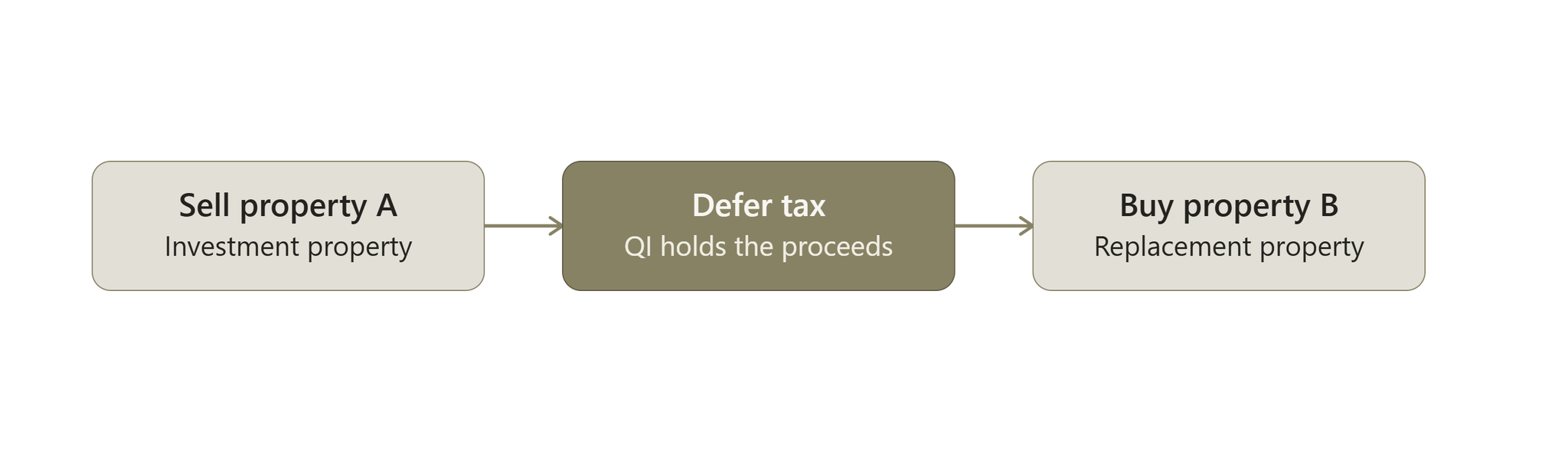
In plain English, a 1031 exchange lets you sell an investment property and buy another one without paying capital gains tax right away. Instead of the IRS taking a cut the moment you sell, that tax bill gets pushed down the road — as long as you follow a specific set of rules.
The name comes from Section 1031 of the Internal Revenue Code, the part of U.S. tax law that spells out this exception. Congress created it to encourage continued investment. The logic is simple: if you're not pulling money out of real estate and putting it in your pocket — you're just moving it from one property into another — you shouldn't be taxed as if you'd cashed out.
That's the heart of it. You're not avoiding taxes forever (in most cases); you're deferring them, which frees up capital to keep working for you right now instead of going to the IRS.
Why Real Estate Investors Use 1031 Exchanges
The tax deferral is the headline, but experienced investors use 1031 exchanges for reasons that go well beyond simply avoiding a tax bill.
Keep More Equity Working for You
When you sell a property outside of a 1031 exchange, a portion of your proceeds goes straight to capital gains tax. That's money that can no longer be reinvested. By deferring the tax, you keep 100% of your equity working for you, which means more buying power for your next property — often enough to move into a larger or higher-value asset than you could have afforded otherwise.
Increase Cash Flow
A 1031 exchange isn't just about deferring tax — it's an opportunity to upgrade. Investors often exchange out of an aging, underperforming property and into an asset with stronger rents, better occupancy, or lower maintenance costs, improving monthly cash flow in the process.
Consolidate or Diversify a Portfolio
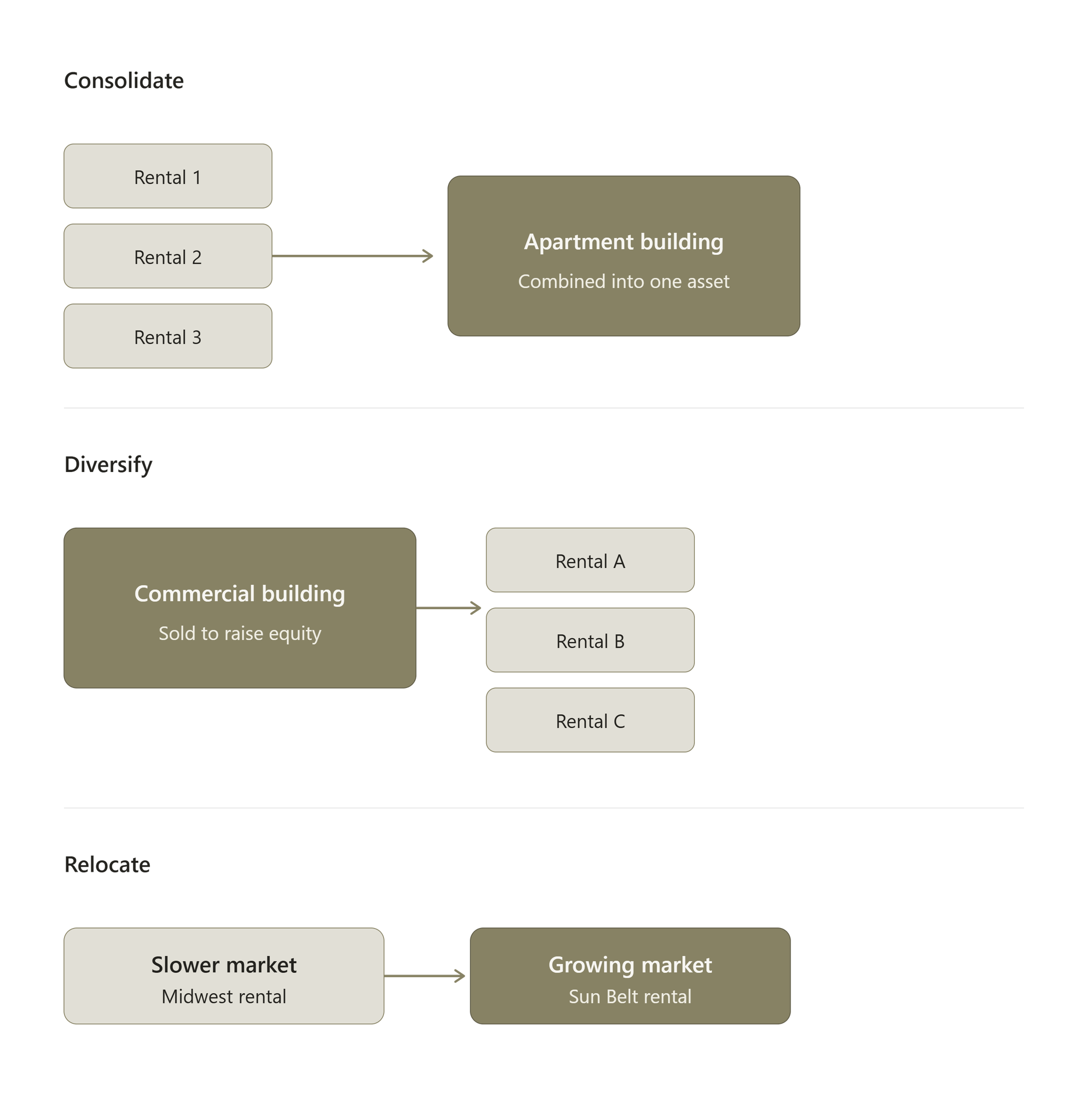
Some investors use a 1031 exchange to simplify their holdings — selling several scattered single-family rentals to acquire one apartment building that's easier to manage. Others do the opposite: exchanging one large commercial property into several smaller rentals to spread out risk across different markets or tenants.
Relocate Investments
Markets change. A property that made sense ten years ago might not be the best place for your money today. A 1031 exchange allows you to move your investment from a slower market into a growing one — without a tax bill forcing you to stay put.
Who Qualifies for a 1031 Exchange?
Investment and Business Properties
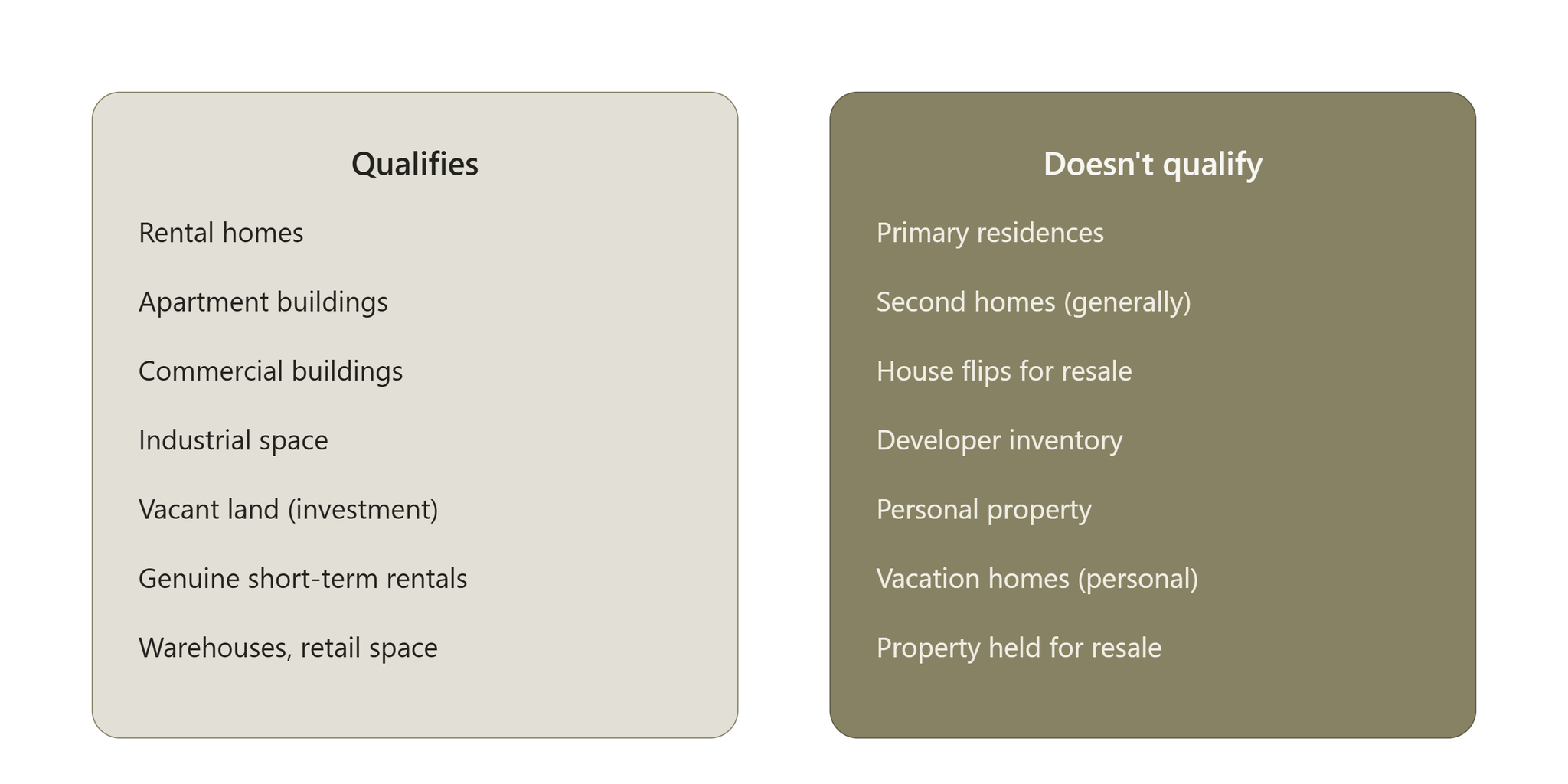
To qualify, the property you sell and the property you buy both need to be held for investment or business use — not personal use. This includes rental homes, apartment buildings, commercial buildings, industrial space, and even raw land held for investment purposes.
What "Like-Kind" Really Means
This is one of the most misunderstood parts of the process. Many people assume "like-kind" means you have to exchange the same type of property — a rental home for another rental home, for example. That's not true. Under current rules, virtually all U.S. real estate held for investment is considered like-kind to other U.S. real estate held for investment, regardless of the property type.
That opens up far more flexibility than most beginners realize. Examples of valid exchanges include:
- A rental home into a fourplex
- A fourplex into a retail building
- A commercial building into vacant land
- An apartment complex into a warehouse
As long as both properties are held for investment purposes, the type of real estate doesn't need to match.
What Doesn't Qualify?
Not every property — and not every seller — qualifies for a 1031 exchange. It's important to understand the exclusions up front, before you get attached to a strategy that won't work.
Properties that generally do not qualify include:
- Primary residences — your own home isn't held for investment
- Second homes, in most cases, unless they're genuinely used as rental investment property
- Property held primarily for resale, such as house flips
- Inventory, like homes built by a developer to sell
- Personal property (this category was eliminated from 1031 treatment in 2018 — only real property now qualifies)
Can You Eventually Move Into the Property?
This is one of the most common questions beginners ask. The short answer: not right away. The replacement property must initially be acquired and held as an investment, not as a future personal residence. The IRS has issued safe harbor guidance suggesting that after a legitimate rental period — generally at least two years, with specific usage limits — an investor may be able to convert the property into a personal residence later on. This isn't something to plan around casually, though; it requires careful timing and documentation, so it's worth discussing with a CPA before you buy.
Can Airbnb Properties Qualify?
Short-term rentals can qualify, but the determining factor isn't whether the property is listed on Airbnb — it's whether the property is genuinely held for investment purposes rather than personal enjoyment. A property you rent out consistently as a business, with minimal personal use, has a much stronger case than a vacation home you occasionally rent out between family stays.
How a 1031 Exchange Works Step by Step
This is where the process gets specific — and where deadlines matter more than almost anything else in real estate.
Step 1 – Sell Your Investment Property
The process begins when you sell your existing investment property. But the groundwork actually needs to happen before this step, since the moment your sale closes, your deadlines start ticking.
Step 2 – Hire a Qualified Intermediary
This is a non-negotiable requirement. You cannot receive the sale proceeds yourself — not even briefly — or the exchange is disqualified. Instead, a qualified intermediary (QI), an independent third party, holds the funds from your sale and later uses them to purchase your replacement property on your behalf. The QI needs to be set up before your property closes, not after.
Step 3 – Identify Replacement Properties Within 45 Days
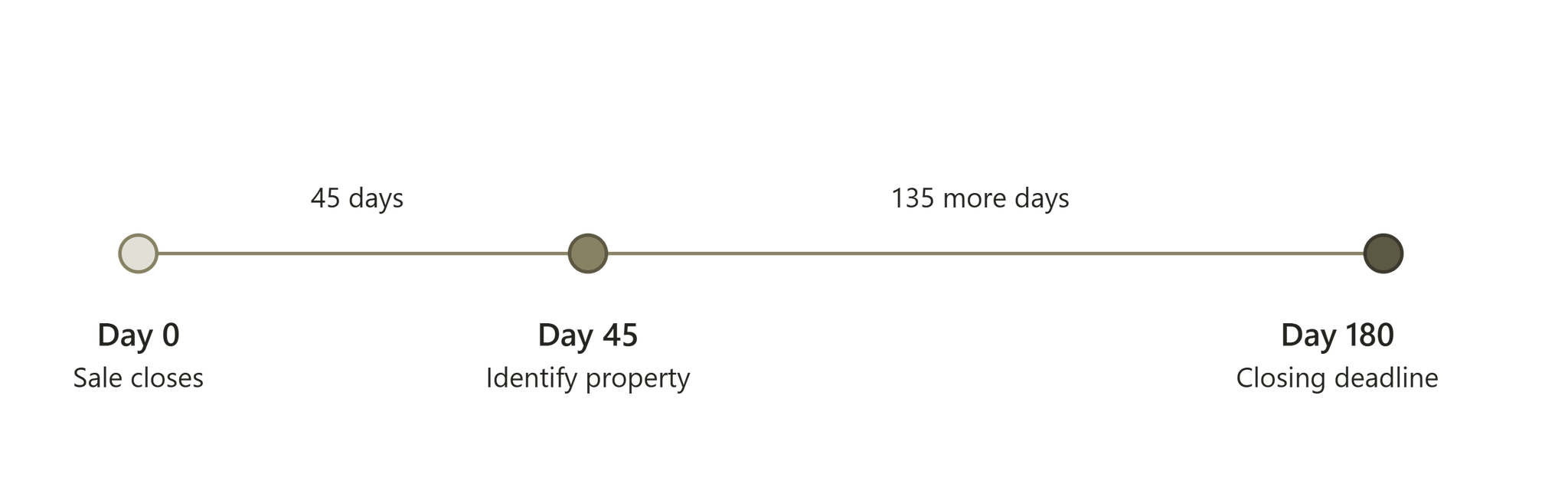
Once your sale closes, the clock starts on your first major deadline: you have 45 calendar days to formally identify potential replacement properties in writing. This includes weekends and holidays — there are no extensions. Most investors identify more than one property as backup, since deals can fall through.
Step 4 – Close Within 180 Days
From the same closing date, you have 180 calendar days total (not 180 days after identification) to close on one or more of the properties you identified. This is a hard deadline set by the IRS.
The Rules That Can Make or Break Your Exchange
Reinvest All the Equity
To defer 100% of your capital gains tax, you generally need to reinvest all of the net proceeds from your sale. If you pull out any cash during the exchange, that portion — often called "boot" — becomes taxable. It doesn't disqualify the whole exchange, but it does create a partial tax bill.
Buy Property of Equal or Greater Value
To fully defer your tax, the replacement property should generally be of equal or greater value than the one you sold, and you should replace any debt you had on the old property (either with new debt or additional cash). Buying "down" in value or paying off debt without replacing it can trigger taxable gain.
Follow the Deadlines
The 45-day and 180-day windows are strict. There are no extensions for financing delays, inspection issues, or a deal falling through at the last minute — which is why identifying backup properties matters so much.
Work With Experienced Professionals
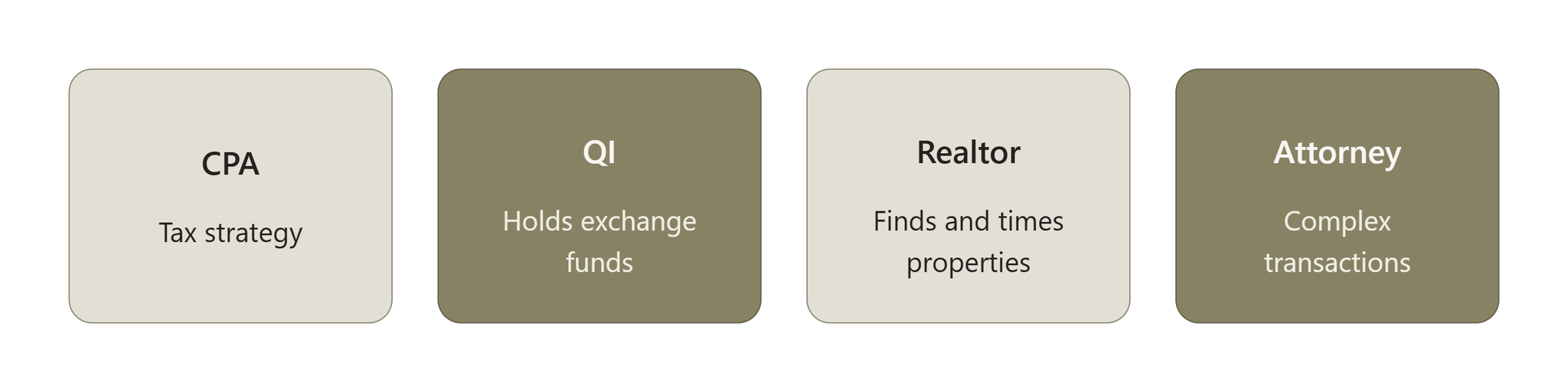
A successful exchange typically involves a small team: a CPA to advise on tax strategy, a qualified intermediary to handle the funds and paperwork, a real estate agent who understands exchange timelines, and sometimes a real estate attorney for more complex transactions. Trying to navigate this alone — especially for a first exchange — is one of the most common ways investors run into trouble.
Common 1031 Exchange Scenarios
Can You Exchange Into a New Construction Property?
Yes, through what's called an improvement exchange (or build-to-suit exchange). The qualified intermediary holds title to the property while construction or improvements are completed, using exchange funds, before transferring it to you. Because this still has to happen within the 180-day window, these exchanges require careful planning and experienced professionals.
Can You Complete a Partial 1031 Exchange?
Yes. Investors don't have to reinvest every dollar. You can intentionally take some cash out of the transaction and pay capital gains tax only on that portion, while still deferring tax on the rest. This is a common strategy when an investor wants to access some liquidity without giving up the tax benefits entirely.
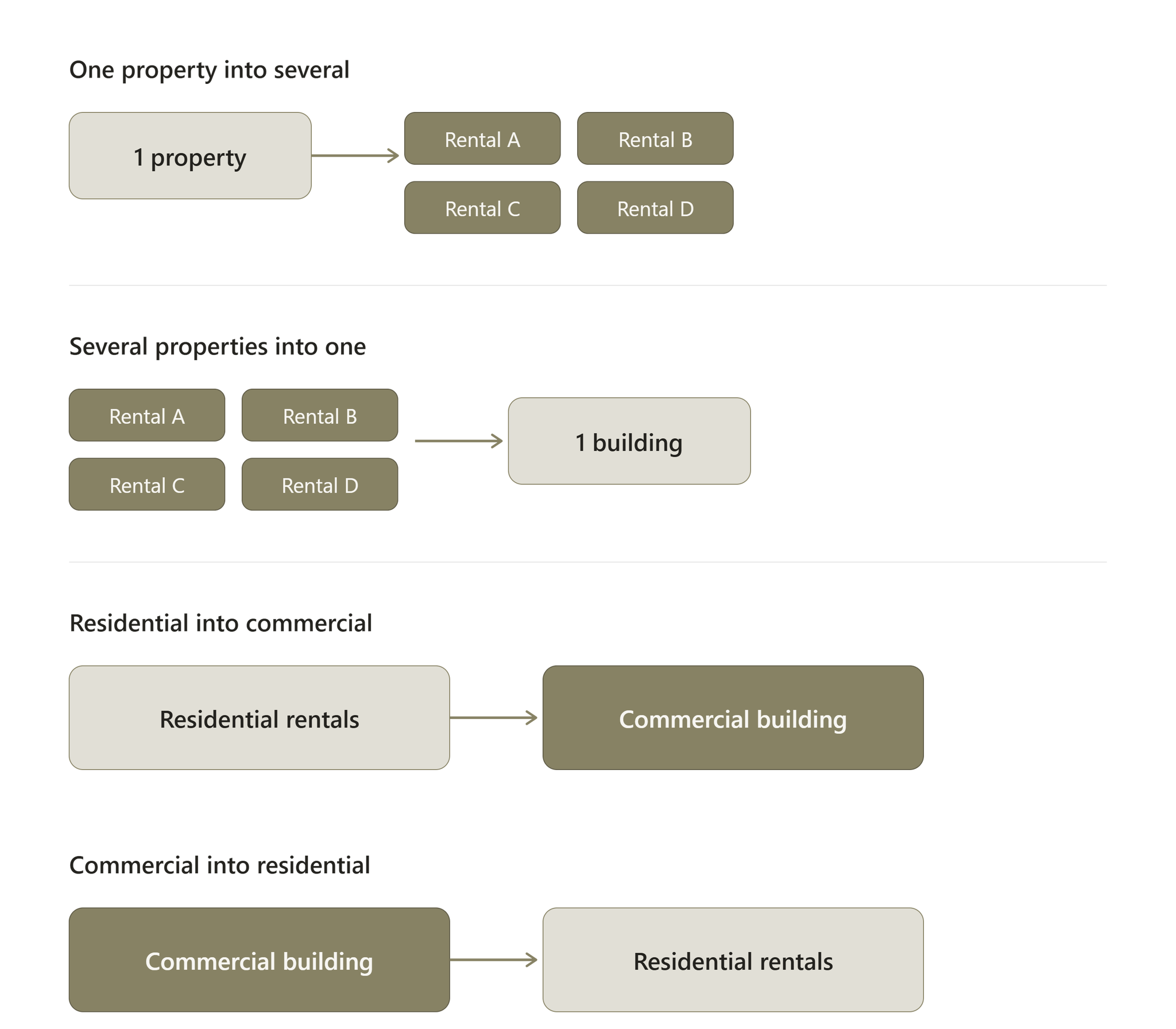
Can You Exchange One Property for Several Properties?
Yes. You can sell a single property and use the proceeds to purchase multiple replacement properties, as long as you stay within the identification and closing deadlines.
Can You Exchange Several Properties for One?
Yes, this works in reverse as well. Investors often sell multiple smaller properties to consolidate into one larger asset, such as an apartment complex.
Can You Exchange Into Commercial Real Estate?
Yes. Because "like-kind" applies broadly to investment real estate, residential rental property can be exchanged into commercial property, and vice versa.
Can You Exchange From Residential to Commercial?
Yes — this is one of the more popular strategies among investors looking to scale. A portfolio of single-family rentals can be exchanged into a commercial building, changing both the management profile and the income potential of the investment.
The Biggest Mistakes Investors Make
Most failed exchanges aren't caused by complicated tax law — they're caused by avoidable, practical mistakes:
- Waiting until after closing to plan. By the time your sale closes, your deadlines have already started. Planning needs to happen before you list the property.
- Touching the sale proceeds. Even briefly receiving funds — instead of routing them through a qualified intermediary — disqualifies the exchange.
- Missing the 45-day deadline. There's no grace period, even for weekends or holidays.
- Underestimating financing timelines. Loan approval can easily eat into your 180-day window if you haven't started early.
- Assuming every property qualifies. Not verifying whether a property is genuinely held for investment before relying on it in an exchange.
- Choosing replacement properties too late. Waiting until close to the 45-day deadline leaves no room if a deal falls apart.
- Trying to save on professional advice. Skipping a CPA or experienced qualified intermediary to save a small fee, then losing far more to a disqualified exchange.
Is a 1031 Exchange Right for You?
A 1031 exchange isn't the right move for every seller. It depends on your goals, your timeline, and where you are in your investing journey.
A 1031 exchange may make sense if you:
- Plan to remain invested in real estate
- Want to defer taxes while growing your portfolio
- Are upgrading into larger or better-performing assets
- Have enough equity to benefit meaningfully from the strategy
It may not be the best option if you:
- Need the sale proceeds for personal use
- Are selling your primary residence
- Plan to leave real estate investing altogether
- Expect your tax situation to make paying capital gains now more advantageous

A successful 1031 exchange doesn't begin when you sign a purchase contract on your replacement property — it begins before you even list your current one. The investors who benefit most are the ones who plan their exchange, assemble their professional team, and understand the deadlines well before the "For Sale" sign goes up.
Check out this article next