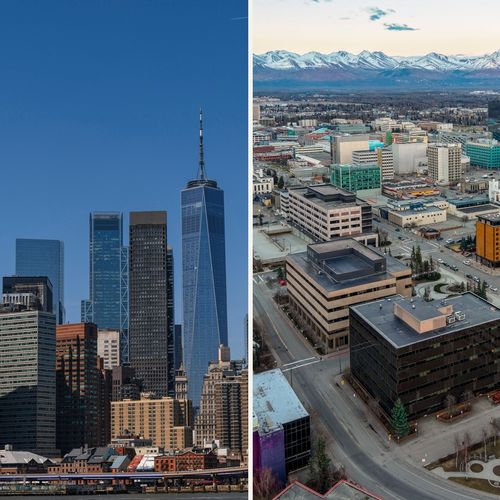
Anchorage is home to about 287,000 people. It is not a giant coastal metropolis. Yet the median sale price over the three months ending in August 2026 was about $465,000—more than Cincinnati or Pittsburgh, and even above Chicago’s roughly $426,000 median.
That comparison stops people. Anchorage has the population of a small city, but its housing costs can look like they belong to a much bigger one. Prices have also kept moving: the Anchorage Economic Development Corporation reports that local home prices rose about 42% over the past decade, while Redfin’s latest three-month figure was 5.7% higher than a year earlier.
So why is Anchorage so expensive?
The short answer is that the city does not have enough homes—especially the ordinary, middle-income homes needed by nurses, teachers, police officers, construction workers, young families, and first-time buyers. The longer answer is that the shortage feeds on itself. It is expensive to build here, old infrastructure makes new projects harder, interest rates squeeze builders and buyers at the same time, and the people needed to build and maintain the city are increasingly priced out of it.
This is the chain behind Anchorage’s broken housing math.
Key Takeaways
The basic problem is supply: Anchorage is adding homes at roughly one-third of the pace local demand requires.
The missing middle is both a housing type and a group of people: duplexes, townhomes, condos, and modest houses are scarce precisely where middle-income workers need them.
Building costs stack: freight, labor, the short construction season, financing, and sometimes $60,000–$80,000 per unit in off-site infrastructure can make an ordinary project stop working.
Mat-Su can offer more house for the money: the sticker price may be similar, but buyers often get a newer home and a larger lot—then pay with time, fuel, and a longer commute.
The shortage reinforces itself: high costs push workers away, labor becomes harder to find, construction gets more expensive, and the city falls further behind.
In This Guide
- Anchorage Housing Costs Like It Belongs to a Much Bigger City
- The Missing Middle Is Not an Abstract Housing Term
- If Homes Are So Expensive, Why Aren’t Builders Building More?
- The Broken Math of an Anchorage Home
- The $60,000–$80,000 Infrastructure Problem Is Not Simply a Tax
- Interest Rates Squeeze the Builder and the Buyer
- Why Buyers Look to Mat-Su Even When the Price Is Similar
- The Commute Creates a Larger Anchorage Problem
- The Housing Problem Becomes a Workforce Problem
- JBER Could Add More Pressure
- Can Anchorage Break the Cycle?
- Frequently Asked Questions
ANCHORAGE HOUSING COSTS LIKE IT BELONGS TO A MUCH BIGGER CITY
Anchorage’s 2025 population estimate was 287,155. That puts it in the same broad size range as Cincinnati and Pittsburgh—not Chicago.
Housing prices tell a very different story.
| City | Approx. population | Median sale price* |
|---|---|---|
| Anchorage | 287,155 | $464,692 |
| Cincinnati | 314,367 | $285,811 |
| Pittsburgh | 307,632 | $274,818 |
| Chicago | 2,731,585 | $426,255 |
*Redfin three-month median sale prices through August 2026. Population estimates are Census 2025 figures. City boundaries and housing mixes differ; the comparison is directional, not an appraisal.
No city-to-city comparison is perfect. Housing stock, geography, taxes, and neighborhood boundaries differ. But the scale of the gap is useful. Anchorage is not merely a little expensive for its size. Its typical sale price sits near—and in this snapshot above—the price of a city almost ten times larger.
That is why housing has become a daily conversation at the municipal and state level. The cost shows up in a buyer’s mortgage, a renter’s lease, an employer’s recruiting problem, and a family’s decision about whether to stay.
THE MISSING MIDDLE IS NOT AN ABSTRACT HOUSING TERM
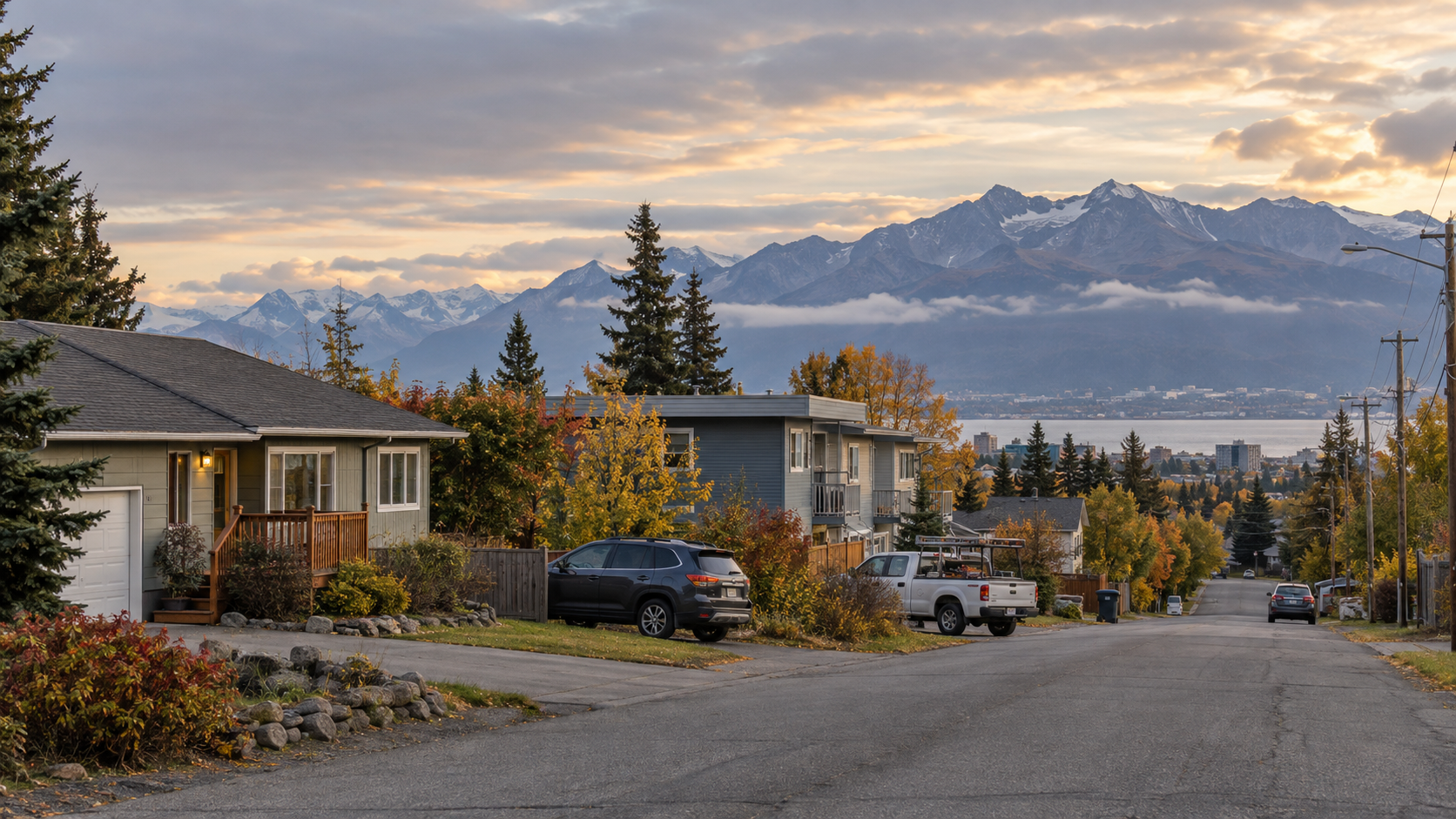
The core problem is a shortage of homes, but not only a shortage of luxury houses or subsidized apartments. Anchorage is short on the middle: duplexes, townhomes, condos, small multifamily buildings, and modest detached houses that working households can realistically rent or buy.
“Missing middle” is a planning term, but it also describes the people caught in the gap. Think of a nurse finishing a night shift, a teacher with two children, a police officer, or a carpenter needed on the next housing project. Their incomes may be too high for assistance and too low for the home the market is producing.
The numbers show how quickly that middle has narrowed. In 2013, 43% of Anchorage home sales were below $300,000. By 2022, that share had fallen to 17%. Over the same period, the share above $400,000 rose from 31% to 53%.
When the ordinary rung of the ladder disappears, people do not stop needing housing. They crowd into rentals, delay buying, accept a longer commute, or leave.
Related Article:The Real Cost of Owning or Renting Property in Anchorage
IF HOMES ARE SO EXPENSIVE, WHY AREN’T BUILDERS BUILDING MORE?
This is the question buyers naturally ask. If a finished home can sell for nearly half a million dollars, shouldn’t builders be rushing to add supply?
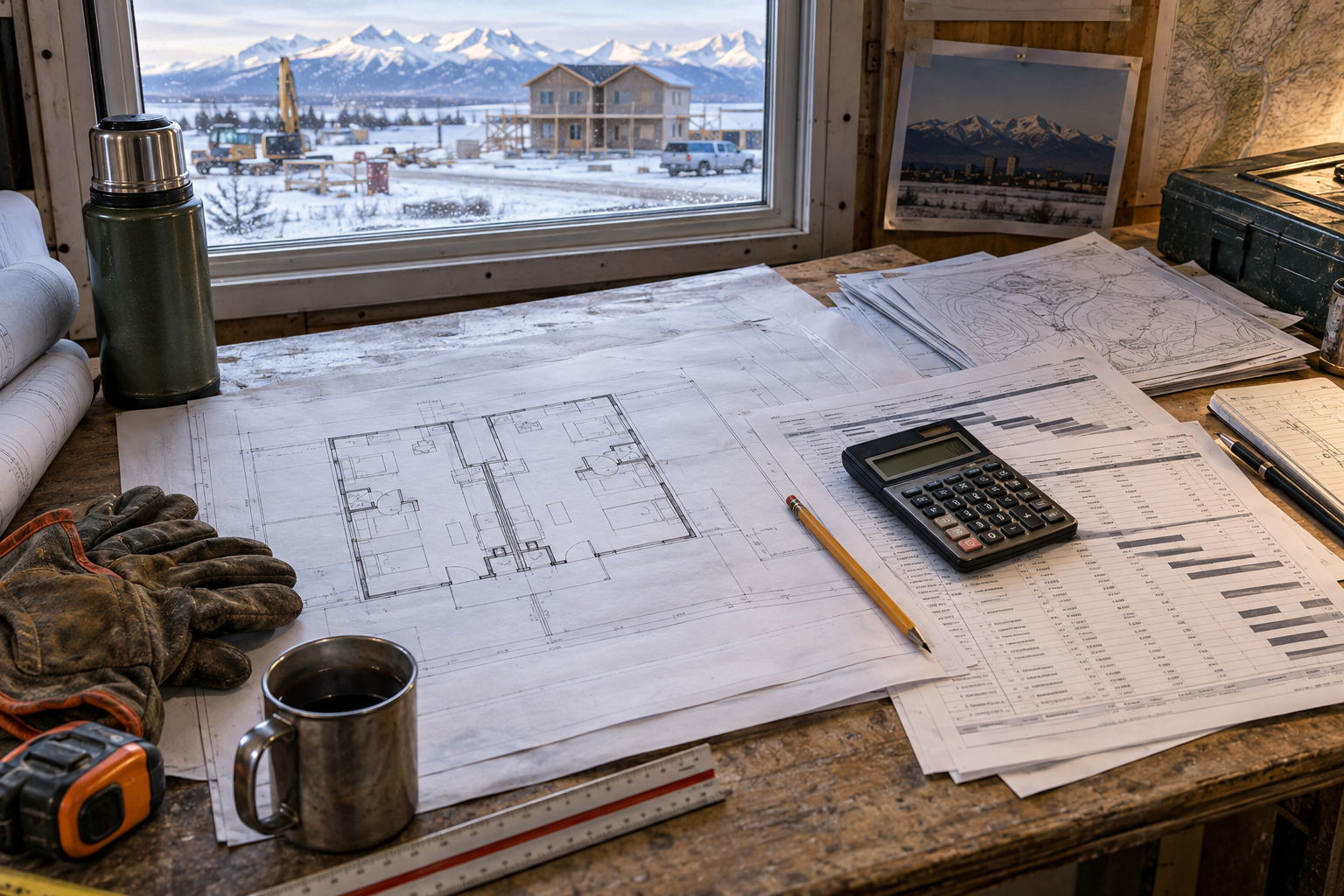
The problem is that the sale price is not the builder’s profit. It is the end of a spreadsheet filled with land, design, permits, financing, labor, lumber, concrete, freight, utility work, roads, drainage, and time. In Anchorage, many of those lines cost more than they do elsewhere.
Materials travel farther. The construction season is shorter. Skilled labor is limited and expensive. Cold-climate design is not optional. Carrying a project through winter can add time and financing cost. Then a seemingly buildable parcel may still need major work before a foundation can go in.
Anchorage built just 402 housing units in 2022, according to the city’s housing strategy report. The report concludes that recent production is roughly one-third of annual demand. High prices do not automatically create supply when the cost and risk of producing the next home rise almost as fast.
THE BROKEN MATH OF AN ANCHORAGE HOME
Imagine a simple home that might sell for $300,000 in a lower-cost market. That is not a quote for a specific house; it is a visual starting point.
In Anchorage, the same project begins absorbing add-ons before the buyer ever sees it. Freight and Alaska labor raise the vertical construction cost. A shorter season and higher financing costs raise the cost of time. On some sites, roads, water, sewer, drainage, or other off-site work can add another $60,000 to $80,000 per unit.
The affordable target does not survive the stack.
Illustration only. The $60,000–$80,000 figure comes from the 2026 Anchorage Housing Development Strategic Report and does not apply to every project.
That is the builder’s problem. The buyer then meets the same price at the other end, with a down payment, closing costs, property taxes, insurance, utilities, and a mortgage rate near 7%.
No single line explains Anchorage. It is the stack that matters.
THE $60,000–$80,000 INFRASTRUCTURE PROBLEM IS NOT SIMPLY A TAX
That infrastructure number deserves careful wording. It is not a universal fee charged to every new home, and it should not be described as an $80,000 city tax.
It is the potential per-unit cost of work outside the building itself: extending or upgrading water and sewer, improving roads, handling drainage, or bringing an older site up to current standards. The exact amount depends on the property and project.
The city is caught in an infrastructure trap. Much of Anchorage was built decades ago. New housing can help modernize a block and broaden the tax base, but the first project may be asked to carry improvements that benefit more than its future residents. Put too much of that cost on the project and the homes become unaffordable—or never get built.
That is how aging infrastructure helps create a vicious circle. The city needs more working households and more taxable property to support upgrades. But the cost of those upgrades can prevent the very housing those households need.
INTEREST RATES SQUEEZE THE BUILDER AND THE BUYER AT THE SAME TIME
Mortgage rates do more than raise a buyer’s monthly payment. They tighten both ends of the housing pipeline.
For a builder, higher rates make land, materials, payroll, and the months before closing more expensive to finance. A project that barely worked at a lower rate may no longer work at all.
For a buyer, the same rate reduces purchasing power. Freddie Mac’s national average 30-year fixed rate was 7.03% on September 24, 2026. At 7%, principal and interest on a $400,000 loan is about $2,661 per month. That is before property taxes, homeowners insurance, mortgage insurance if applicable, utilities, and maintenance.
Rates therefore do not fix Anchorage’s shortage by cooling demand. They can suppress demand temporarily while also suppressing the construction needed to improve supply.
WHY BUYERS LOOK TO MAT-SU EVEN WHEN THE PRICE IS SIMILAR
The Mat-Su Valley is often described as the cheaper alternative to Anchorage. That is only partly true.
AEDC reported an average single-family price of about $481,400 in Anchorage during the first half of 2026 and about $474,200 in Mat-Su. The prices were close. The product was not.
In the Valley, a buyer can often get a newer home, a larger lot, and less deferred maintenance for roughly the same sticker price. In Anchorage, the same budget may buy an older house on a smaller lot with more immediate work.
That is why “drive until you qualify” is not only about finding a lower price. It can mean driving until the same payment buys more house.
The tradeoff is the commute. Fuel, vehicle wear, winter driving, and hours spent on the Glenn Highway are part of the real monthly cost. For some households, the space is worth it. For others, proximity to work, school, medical care, and daily errands matters more.
THE COMMUTE CREATES A LARGER ANCHORAGE PROBLEM
When workers move to Mat-Su but keep jobs in Anchorage, the housing decision becomes a regional infrastructure issue.
Those commuters are essential to Anchorage. They staff hospitals, schools, public safety, construction sites, offices, and businesses. They also spend money in the city. At the same time, their residential property taxes are paid in Mat-Su while much of their workday demand falls on Anchorage roads, public services, and infrastructure.
That does not make commuters the problem. It shows that the housing market no longer fits neatly inside municipal boundaries. Anchorage can lose residents and tax base without losing the daily need for their labor—or the infrastructure load created by a regional workforce.
THE HOUSING PROBLEM BECOMES A WORKFORCE PROBLEM—AND THEN LOOPS BACK
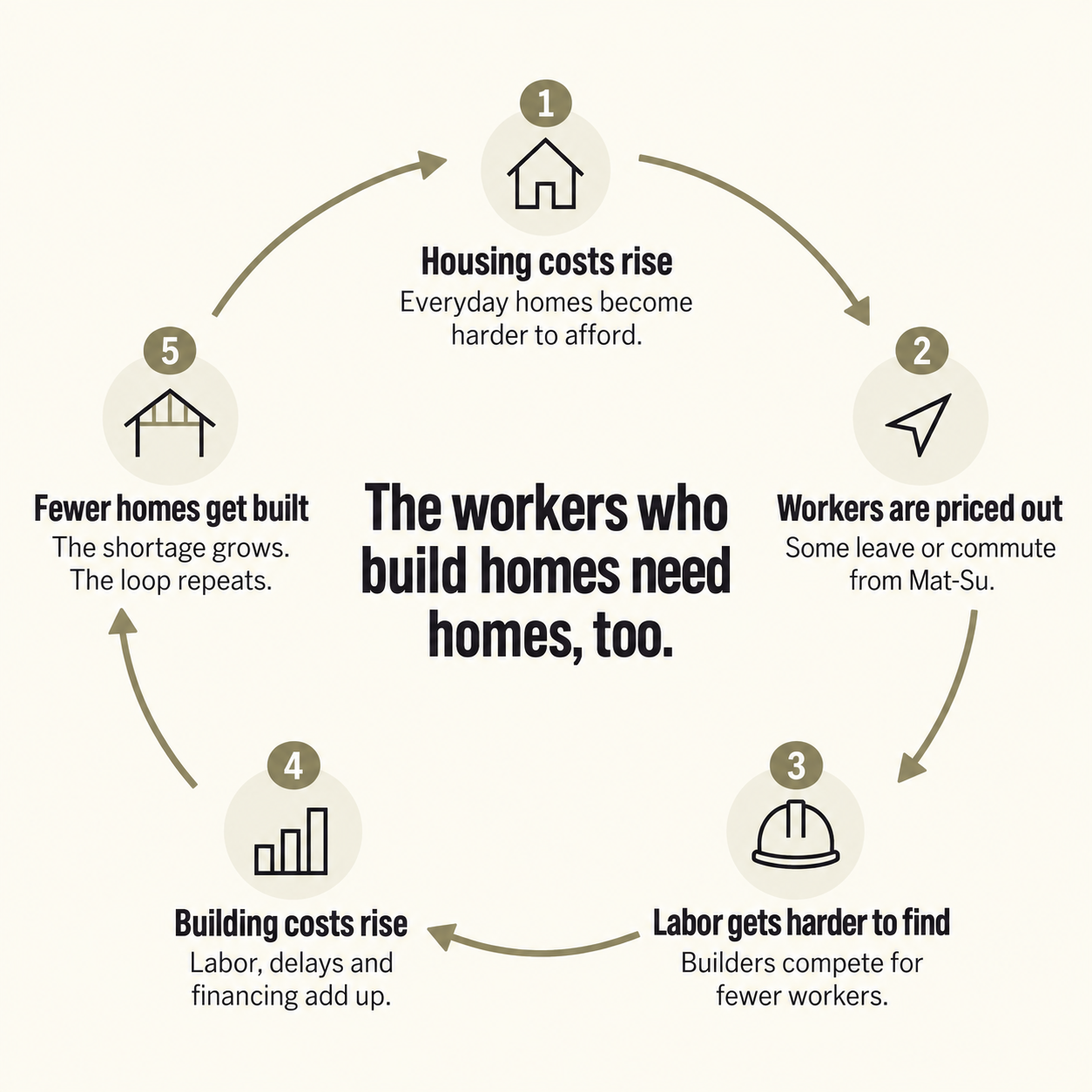
This is the central loop:
Housing costs rise. Middle-income workers leave, commute farther, or decline a job in Anchorage. Employers struggle to recruit. Labor becomes scarcer and more expensive. Construction and public projects cost more. Fewer homes get built. Housing costs rise again.
The builder is caught inside the same loop. The workers needed to build housing cannot easily afford housing near the job. The city then has fewer younger households paying taxes, starting businesses, and helping fund the infrastructure upgrades the next project needs.
Anchorage’s housing problem is therefore not separate from healthcare staffing, school recruitment, public safety, or construction capacity. It sits underneath all of them.
JBER COULD ADD MORE PRESSURE TO A MARKET WITH LITTLE SLACK
Projected growth at Joint Base Elmendorf-Richardson could add another 2,600 to 2,800 service members and family households to the Anchorage market over the next several years.
That growth is good economic news. It also arrives in a market already short of available homes and rentals. Local estimates suggest the private-market housing gap connected to JBER could approach 3,500 units by 2030 if supply does not catch up.
The exact timing depends on federal decisions and military plans, so those numbers should be treated as projections rather than a completed move-in count. The direction is still clear: more households competing for a thin supply means more pressure on rents, entry-level homes, and everyday workforce housing.
CAN ANCHORAGE BREAK THE CYCLE?
Anchorage is taking steps: allowing more housing types, reviewing development rules, using public land, and looking for ways to share or reduce infrastructure costs. Permitting has improved from the lowest years, but the city remains far behind the accumulated need.
This article is not an argument for one political solution. The practical point is simpler. No single change can fix a cost stack created by land, labor, logistics, infrastructure, financing, and time. Anchorage needs more homes that ordinary working households can actually use, and it needs enough production for that middle of the market to stop disappearing.
For buyers, the lesson is not “wait for the shortage to end.” It is to compare the full cost of each option: purchase price, rate, condition, utilities, likely repairs, commute, and time. A newer Valley home and an older Anchorage home can have similar prices but very different lives attached to them.
Comparing Anchorage With the Valley?
Price alone does not show what you are buying. Condition, heating, commute, utilities, road service, and future maintenance all matter.
I can help you compare the real monthly cost before you commit to either side of the highway.
FREQUENTLY ASKED QUESTIONS
Why is housing so expensive in Anchorage?
What does “missing middle” housing mean in Anchorage?
Is the $60,000–$80,000 infrastructure cost an Anchorage tax?
Is Mat-Su actually cheaper than Anchorage?
Will more construction lower Anchorage home prices?
How could JBER growth affect Anchorage housing?
Source notes: Population figures are 2025 Census estimates. Median sale prices are Redfin three-month figures through August 2026. Anchorage price growth and the Anchorage–Mat-Su comparison come from the 2026 Anchorage Economic Trends Report. Housing production, the projected 21,000-unit shortage by 2040, sales-by-price-band history, and the possible $60,000–$80,000 per-unit infrastructure cost come from the 2026 Anchorage Housing Development Strategic Report. The mortgage-rate reference is Freddie Mac’s September 24, 2026 Primary Mortgage Market Survey. JBER figures are projections and remain dependent on federal and military plans. Data was checked September 27, 2026.
Check out this article next